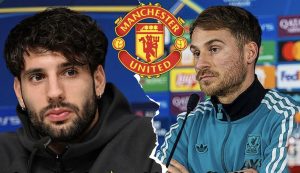
The PSG manager is said to have accepted the player’s decision after being informed that Old Trafford was his preferred destination, despite strong interest from Arsenal.
HE SNUBBED ARSENAL FOR A MAN UNITED MOVE
Manchester United appear to have landed a significant psychological and sporting victory in the race for one of Europe’s most dynamic young attackers after reports emerged that Paris Saint-Germain star Bradley Barcola has made his preference for a move to Old Trafford crystal clear. According to claims attributed to PSG head coach Luis Enrique, the French champions deliberately rejected an approach from Arsenal once it became apparent that the 23-year-old only had eyes for a switch to Manchester United.
The reported comments from Enrique carry particular weight. The Spanish coach, who has overseen Barcola’s development since the forward’s arrival from Lyon in 2023, is understood to have confirmed that the player’s stance left the club with little choice. “We deliberately turned down Arsenal’s offer because he made it clear to me that he only wanted a Manchester United move. You cannot force a player against his own wishes,” Enrique is said to have stated. The implication is that any attempt to push Barcola towards north London would have risked damaging the relationship between player and club, potentially creating dressing-room friction at a time when PSG continue to pursue their own ambitious objectives.
Barcola’s preference for United over Arsenal has sent ripples through the Premier League transfer landscape. Both clubs have long admired the France international, whose blend of blistering pace, close control, and directness has made him one of the most exciting wide forwards of his generation. Arsenal, under Mikel Arteta, have been linked with the player throughout the summer as they look to bolster their attacking options. Yet according to the latest reports, those efforts have been stymied by the player’s own determination to head to Old Trafford instead.
Born on 2 September 2002 in Villeurbanne, near Lyon, Bradley Jean-Manuel Essolisam Addo Barcola rose through the ranks at Olympique Lyonnais before making the high-profile switch to PSG in the summer of 2023 for a fee reported in the region of €45 million. At Lyon he had already shown the attributes that would later turn heads across Europe: explosive acceleration, the ability to beat defenders in one-on-one situations, and an eye for both goals and assists. His breakthrough campaign with Les Gones earned him recognition as one of Ligue 1’s outstanding young talents and paved the way for the move to the French capital.
At PSG, Barcola has continued to develop while competing for minutes in a squad stacked with attacking quality. He has contributed goals and assists across domestic and European competitions, helped the club secure major silverware, and earned regular call-ups to the senior France national team. His performances at the 2026 World Cup further enhanced his reputation, underlining his capacity to deliver on the biggest stages. Yet the intensity of competition for starting places in Luis Enrique’s side has also created periods of frustration, with the player sometimes finding himself on the periphery of the starting XI. Those circumstances are understood to have contributed to his openness to a new challenge.
Manchester United’s interest in Barcola is rooted in the club’s ongoing efforts to add pace, creativity and goal threat to the forward line. The Red Devils have been searching for a dynamic wide option capable of stretching defences, linking with central attackers, and providing a consistent threat in transition. Barcola’s profile fits many of those requirements. At 23 he still has significant scope for further improvement, yet he already possesses the experience of Champions League football, Ligue 1 title challenges and senior international appearances. His preferred position on the left flank, combined with the ability to operate on the right or even through the middle, offers valuable tactical flexibility.
The reported decision to prioritise United over Arsenal will be analysed extensively. Arsenal’s project under Arteta has been widely praised for its structure, intensity and clear identity. Many observers would have viewed a move to the Emirates as a natural fit for a young French attacker seeking regular football and a platform to shine. That Barcola is said to have rejected that path in favour of Old Trafford suggests a strong personal conviction about the opportunity awaiting him in Manchester. Whether that conviction stems from the club’s recent recruitment, the chance to work with specific coaches, the pull of the Premier League’s global stage, or simply a preference for the United project remains a matter of speculation. What is clear, according to the reports, is that the player communicated his wishes firmly enough for Enrique and PSG to respect them.
From PSG’s perspective, the situation presents both challenges and opportunities. The club has publicly maintained a firm stance on key squad members in recent windows, often insisting that certain players are not for sale. High valuations have been placed on assets of Barcola’s quality, with figures in excess of €100 million circulating in previous reports. Yet when a player of his standing makes clear that his heart lies elsewhere, the dynamic shifts. Enrique’s reported acceptance of the situation reflects a pragmatic understanding that forcing an unwilling player to remain can prove counterproductive. At the same time, any departure would generate substantial funds that could be reinvested into the squad, potentially easing the path for other targets or reinforcing areas of need.
United’s ability to convince Barcola that Old Trafford represents his ideal next step will be viewed as a notable success in a competitive market. The Premier League’s major clubs have all shown interest in elite young attackers this summer, and the competition for players of Barcola’s calibre is intense. Landing a target who has actively chosen the club over a direct rival carries symbolic as well as sporting value. It signals that the project at Manchester United retains significant appeal for top talents, even when alternative destinations of comparable prestige are available.
Tactically, Barcola would bring a different dimension to United’s attack. His ability to attack space behind defences, combine quickly in tight areas, and finish with either foot makes him a constant threat. Defensively, modern wide forwards are expected to contribute to the press, and Barcola has shown the work rate required at the highest level. Integration into a new system would take time, yet the raw tools he possesses suggest he could adapt quickly to the physical and tactical demands of English football.
The financial aspects of any potential deal will be closely scrutinised. PSG are unlikely to sanction a departure without receiving a fee that reflects Barcola’s age, contract situation (his current deal runs until 2028) and proven quality. United, for their part, must balance ambition with the realities of squad planning and financial regulations. Structured payments, performance-related add-ons and careful management of the wage bill would all form part of negotiations. The fact that the player is understood to favour the move could, however, give United a degree of leverage in discussions that might otherwise prove protracted.
Broader implications for both clubs are significant. For Arsenal, the reported snub represents a setback in their efforts to strengthen the forward line. The Gunners have explored multiple options and will continue to do so, yet missing out on a player of Barcola’s profile after investing time and energy in the pursuit is never ideal. For Manchester United, successful completion of the transfer would represent a statement of intent and a tangible boost to the attacking ranks. It would also reinforce the sense that the club is capable of winning battles for high-priority targets even against established rivals.
Barcola’s own career trajectory remains the central thread. From the Lyon academy to the Champions League stage with PSG and the international arena with France, he has consistently risen to new challenges. A move to the Premier League would represent another step up in intensity and scrutiny. The league’s weekly demands, physicality and tactical variety have tested many continental talents; those who adapt successfully often reach new heights. At 23, Barcola is young enough to grow into the role of a cornerstone attacker yet experienced enough to contribute immediately.
Luis Enrique’s reported remarks have crystallised the narrative. By acknowledging both the Arsenal approach and the player’s clear preference for Manchester United, the PSG coach has effectively confirmed that the decisive factor was Barcola’s own will. In an era when player power increasingly shapes the transfer market, such clarity can accelerate or halt deals more effectively than any amount of club-to-club negotiation. “You cannot force a player against his own wishes,” Enrique is said to have observed. Those words encapsulate the reality facing PSG and the opportunity now presenting itself to Manchester United.
As the window continues, attention will turn to whether the reported preference translates into concrete progress. Personal terms, agreement on a fee, and the formalities of a transfer would still need to be resolved. Until those steps are completed, the situation remains fluid. Yet the combination of a player’s stated desire, a manager’s public acceptance of that desire, and the interest of a major Premier League club has created genuine momentum. Bradley Barcola’s next chapter may well be written in the red of Manchester United rather than the colours of Arsenal or the continued service of Paris Saint-Germain.
The story of a talented young forward choosing one elite destination over another is hardly unique. What elevates this particular episode is the reported directness with which the choice was communicated and the willingness of a major European club to respect it. For Manchester United supporters, the prospect of adding a player of Barcola’s dynamism and quality is an exciting one. For Arsenal, it serves as a reminder of the fine margins that often decide transfer battles. And for Bradley Barcola himself, it marks the moment when he made clear where he believes his future lies.