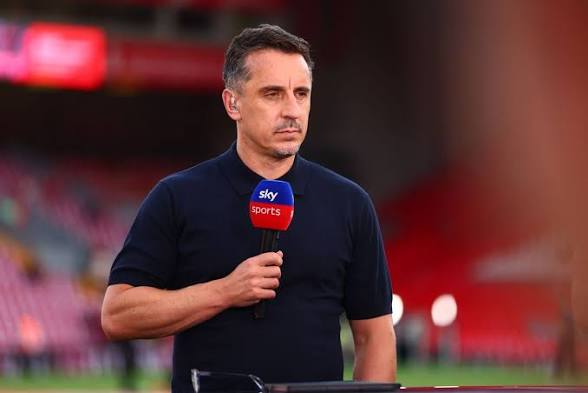
“I want to know who is making the decision to let Harry Amass leave Manchester United for £6 million! Because I don’t understand it. Manchester United has been talking about needing a left-back all summer. Meanwhile… they’ve got food at home,” Neville declared.
The former United captain and current pundit used Amass’s display in the preseason clash with Leeds as the platform for a broader critique of the club’s recruitment approach, arguing that the 18-year-old has already shown enough to deserve a genuine opportunity in the first-team picture rather than being moved on for a modest fee.
Neville’s comments come at a time when Manchester United have spent much of the summer linked with various left-back targets. The position has been a recurring topic of discussion, with the need for greater depth and long-term quality frequently highlighted. Against that backdrop, Amass’s performance against Leeds — described by Neville as comfortable and mature — has been held up as evidence that the solution may already be inside Carrington.
The youngster has spent time away from Old Trafford on loan, gaining senior experience and developing his game. Those periods are understood to have accelerated his progress, allowing him to return with greater physicality, improved decision-making and a clearer understanding of the demands of first-team football. Neville pointed specifically to those qualities, noting that Amass possesses the physical attributes required, is comfortable in possession, shows bravery in his play, and retains the advantage of significant room for further development.
“This is a young left-back who has gone out on loan twice, gained experience, performed well, and now he’s back, looked very comfortable and mature against Leeds today,” Neville said. “Sometimes at this club we look everywhere else for a solution when the solution is already sitting inside Carrington.”
The £6 million figure cited by Neville has become a focal point of the discussion. Selling a homegrown player with Amass’s profile for that sum would, in the pundit’s view, represent a significant undervaluation — particularly if the club then moved to spend several times that amount on an external alternative. “If United sell him for £6 million and then spend £40, £50 or £60 million trying to solve the same position, I’ll be asking serious questions,” he added.
The intervention reflects a wider tension that has surfaced repeatedly at Manchester United in recent years: the balance between trusting academy graduates and pursuing established or high-profile external options. Neville, who came through the ranks himself and formed part of the famous Class of ’92, has consistently advocated for giving young players meaningful opportunities when they demonstrate the required qualities. His comments on Amass sit firmly within that tradition.
Harry Amass’s pathway has followed a familiar modern pattern for high-potential academy players. Early recognition within the youth system was followed by loan moves designed to provide regular senior minutes and exposure to the physical and tactical demands of competitive football. Those experiences are intended to bridge the gap between under-21 football and the Premier League. Against Leeds, the evidence of that development was, according to Neville, clearly visible in the youngster’s composure, positioning and willingness to engage both defensively and in possession.
Left-back has been an area of relative uncertainty for United across multiple seasons. Various solutions have been trialled, with differing levels of success. The search for a long-term occupant of the position has driven transfer speculation throughout the current window. Neville’s argument is that the club risks overlooking a player who already understands the environment, has shown progress, and still has the capacity to grow into the role over several seasons.
The physical profile Neville highlighted is particularly relevant. Modern full-backs are expected to cover large distances, contribute in both phases of play, and handle the intensity of weekly Premier League fixtures. Amass’s ability to cope with those demands while remaining composed on the ball was presented as a strong foundation. Bravery — the willingness to receive under pressure, to take on responsibility, and to recover defensively — was cited as another encouraging trait.
Age remains a central part of the case. At a stage when many players are still adjusting to senior football, Amass retains several years of potential development. Neville’s point that the club does not need to know the exact ceiling, only to provide the opportunity to discover it, speaks to a developmental philosophy that prioritises minutes and trust over immediate perfection. Selling the player now, he suggested, would close off that possibility for a relatively small financial return.
The alternative scenario Neville sketched — disposing of Amass for £6 million and later spending £40 million, £50 million or £60 million on a different left-back — has resonated with sections of the support. Homegrown players who leave and subsequently thrive elsewhere often become sources of lasting regret. Conversely, those given genuine chances and who go on to establish themselves tend to be remembered as success stories of the academy system. The current discussion around Amass sits at that familiar crossroads.
Michael Carrick’s role in the situation will be decisive. The head coach has the responsibility of selecting the squad and determining which young players are ready for greater involvement. Preseason fixtures provide a controlled environment in which to assess precisely those questions. Amass’s display against Leeds has, at the very least, strengthened the argument that he merits further opportunities in the remaining friendly matches and, potentially, in the early stages of the competitive season.
United’s wider recruitment strategy continues to evolve under the current ownership and coaching structure. The emphasis on data, specific profiles and long-term planning has been well documented. Neville’s intervention serves as a reminder that internal options — particularly those who have already been developed within the system — should form part of that calculation. Overlooking a player who has shown progress risks both sporting and financial inefficiency.
The reaction to Neville’s comments has been predictable in its intensity. Many supporters have echoed the view that Amass deserves a proper run of opportunities before any decision is taken on his future. Others have cautioned that one solid preseason performance does not automatically translate into Premier League readiness, and that competition for places remains high. The debate itself, however, has elevated the youngster’s profile and placed the left-back discussion firmly back in the spotlight.
For Amass the coming weeks will be significant. Further strong performances in preseason would make it increasingly difficult to justify any move away from the club. Consistent involvement in training and a clear pathway into matchday squads would provide the platform Neville insists he needs. Conversely, limited opportunities could renew speculation about a departure, whether permanent or on loan.
The broader academy context at Manchester United adds weight to the discussion. The club has a long and proud history of producing first-team players, yet the transition from promising youngster to established senior performer remains challenging. Loan spells have become a standard tool for bridging that gap. When those loans produce tangible improvement, the expectation is that the player returns with a genuine chance to prove himself. Neville’s argument is that Amass has reached precisely that point.
Financial considerations cannot be ignored. A £6 million fee for a homegrown player would represent pure profit under the relevant accounting rules and would free up a squad place. Yet the opportunity cost — the potential need to spend several times that amount on an external alternative — forms the core of Neville’s objection. In an era of heightened scrutiny around squad investment and sustainability, the efficiency of developing and retaining internal talent carries increasing importance.
Carrick’s public comments on the left-back position and on Amass specifically will be awaited with interest. Managers often prefer to keep selection discussions private, yet the intensity of Neville’s intervention may prompt some form of response or clarification as the preseason programme continues. The remaining fixtures offer further opportunities for the young defender to state his case on the pitch.
In the meantime, the discussion sparked by Neville has crystallised a familiar tension at Old Trafford. The search for external solutions to long-standing positional needs continues, while a young player who has taken the developmental steps asked of him waits for the chance to show what he can do. Against Leeds he produced a performance that, in the eyes of one of the club’s most respected former players, demonstrated readiness for greater responsibility.
Whether that performance marks the beginning of a sustained opportunity or remains an isolated highlight will depend on the decisions taken in the coming days and weeks. Gary Neville has made his position clear: the solution to United’s left-back questions may already be inside the building. Selling that solution for a modest fee, only to invest heavily in an alternative, would, in his view, invite serious questions. The club’s next moves in the position will determine whether those questions need to be asked.