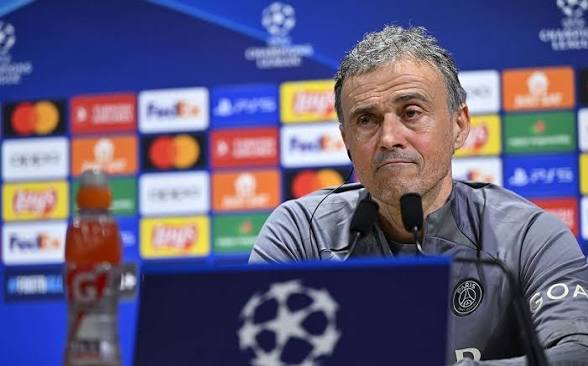
Paris Saint-Germain manager Luis Enrique has reportedly confirmed that the club deliberately rejected formal approaches from both Arsenal and Manchester United for Bradley Barcola after the France international made his preferred destination crystal clear. According to the claims, the player informed the hierarchy at the Parc des Princes that he only wanted a move to Liverpool, leaving the Spanish coach with little choice but to respect that stance.
“We deliberately turned down offers from Arsenal and Manchester United because he made it clear to me that he only wanted a Liverpool move. You cannot force a player against his own wishes,” Enrique is said to have revealed. The PSG boss is understood to have accepted the decision once he was informed that Anfield was Barcola’s firm first choice, despite the strong interest shown by the two other Premier League heavyweights.
The comments, if accurate, would represent a significant public acknowledgement of a transfer that has been building momentum throughout the summer window. They also underline the growing power of player preference in modern elite football, where even clubs of PSG’s stature are reluctant to force a departure against a star’s clearly expressed wishes.
Bradley Barcola, born on 2 September 2002 in Villeurbanne, is 23 years old and already one of the most dynamic wide forwards in European football. A product of the Lyon academy, he broke into the first team there before completing a high-profile €45 million move to Paris Saint-Germain in the summer of 2023. Since arriving in the capital he has collected multiple Ligue 1 titles, Coupe de France trophies, and two UEFA Champions League medals as part of a side that has established itself as a genuine continental force under Luis Enrique. Known for his blistering pace, direct dribbling, and ability to stretch defences from either flank or through the middle, Barcola has developed into a constant threat on the counter and in transition.
His international career has followed a similar upward trajectory. Regular involvement with France, including appearances at major tournaments, has cemented his status as one of the country’s brightest attacking talents. Yet despite the silverware and the individual progress, frustration has grown over his role at PSG. Often used as an impact substitute rather than a guaranteed starter, particularly in the biggest matches, Barcola has seen limited consecutive minutes in a squad packed with elite attacking options. That situation is widely believed to have driven his decision not to extend a contract that runs until 2028, opening the door to a potential exit this summer.
Interest from Premier League clubs has been intense. Arsenal have long admired the Frenchman, viewing him as a potential long-term solution on the left or as a versatile option capable of adding another dimension to Mikel Arteta’s attack. Manchester United, simultaneously reshaping their forward line, are also understood to have made serious enquiries and prepared concrete offers. Both clubs saw in Barcola a ready-made Premier League-ready talent with the physical attributes and technical quality to thrive immediately. Yet according to the reported comments from Enrique, those approaches were rebuffed once Barcola’s camp made Liverpool the non-negotiable priority.
Liverpool’s interest is rooted in clear squad needs. With Mohamed Salah having departed at the end of last season, the Reds have been actively searching for a high-calibre wide forward capable of providing goals, assists, and the kind of direct threat that defined the Egyptian’s peak years. Barcola’s profile — right-footed but comfortable on the left, explosive in one-on-one situations, and increasingly clinical in front of goal — maps neatly onto those requirements. Reports throughout the window have indicated that personal terms between the player and Liverpool were progressing positively, with the winger said to be excited by the project at Anfield and the prospect of regular first-team football under the current coaching setup.
The financial parameters of any deal remain the major obstacle. PSG are understood to value Barcola in the region of €150 million, using recent high-profile Premier League transfers as benchmarks. Liverpool have been linked with figures closer to €120 million, leaving a gap that will require further negotiation. The fact that both clubs share certain commercial and ownership connections has been cited as a potential facilitator for dialogue, while Barcola’s refusal to sign a new deal in Paris strengthens the Reds’ hand. Still, extracting a player of this quality from a club that has no urgent need to sell is never straightforward.
Enrique’s reported willingness to accept the player’s preference is noteworthy. The Spaniard has overseen an era of sustained success at PSG, blending star power with a more collective, high-pressing style. Losing a versatile, high-upside attacker of Barcola’s calibre would create a gap, yet the manager’s apparent pragmatism suggests a recognition that an unhappy player can become a disruptive one. “You cannot force a player against his own wishes” is a phrase that carries weight in dressing-room culture. By publicly or semi-publicly acknowledging Barcola’s stance, Enrique may also be managing expectations around the squad’s future composition and signalling that the club prioritises harmony where possible.
For Arsenal and Manchester United, the alleged snub would rank as a clear setback. Both clubs invested time and resources in assessing the player and preparing offers. Arsenal, in particular, have a track record of identifying and securing young French talent, and missing out on Barcola would leave them searching for alternative solutions on the flanks. Manchester United’s midfield and attacking rebuild has already seen significant investment; adding Barcola would have provided another high-ceiling option, but the reported preference for Liverpool appears to have closed that avenue.
From Liverpool’s perspective, securing a player who has actively chosen Anfield over two major rivals would carry both footballing and psychological value. It would reinforce the club’s status as a destination of choice for top talents and provide an immediate boost to an attack that has been reshaped following Salah’s exit. Barcola’s ability to play across the front line would also give the manager tactical flexibility, whether deploying him as a traditional wide forward, an inverted threat, or even as a central option in certain systems. His experience of winning the Champions League at a young age would further strengthen a squad already containing proven winners.
The wider transfer market context adds another layer. Fees for elite wide attackers have inflated dramatically, and Barcola’s combination of age, international pedigree, and proven output at the highest level places him firmly in the nine-figure bracket. Whether Liverpool ultimately meet PSG’s valuation or the two sides find a compromise will determine if the reported preference becomes reality. Negotiations are understood to be ongoing, with both parties described in recent reporting as confident that a resolution can be found before the window closes.
Barcola himself has maintained a relatively low public profile on the speculation, allowing his performances for club and country to speak. Those who have watched him closely highlight not only the pace and dribbling that first caught the eye at Lyon, but also an improving end product and a growing understanding of when to take risks and when to recycle possession. At 23 he still has significant development ahead of him, yet he already possesses the tools to make an instant impact in the Premier League’s intensity.
If the claims surrounding Luis Enrique’s comments prove correct, they mark a decisive moment in this particular transfer saga. A player of Barcola’s quality actively steering clear of Arsenal and Manchester United in favour of Liverpool would represent a notable coup for the Merseyside club and a public demonstration of the Reds’ continued pulling power. For PSG it would mean the departure of a key squad member, but one handled with a degree of mutual respect rather than acrimony.
The coming days and weeks will reveal whether the reported preference translates into a completed transfer. Fees must still be agreed, medicals passed, and contracts finalised. Yet the narrative that has emerged — of a star who knew exactly where he wanted to go and a manager prepared to honour that choice — has already added a compelling human dimension to the story. In an era of complex multi-club negotiations and ever-rising valuations, the simple fact of a player’s clear desire can still prove decisive.
Liverpool fans will be watching developments closely, hopeful that the reported snub of two major rivals ultimately leads to a new face at Anfield. Arsenal and Manchester United supporters, meanwhile, will be left reflecting on what might have been. And at the centre of it all stands Bradley Barcola, a young forward whose next career step could define the next phase of his trajectory — and reshape the attacking options of one of English football’s biggest clubs.