Nigeria’s higher education system has once again made global headlines as the Times Higher Education (THE) World University Rankings 2026 reveal the nation’s most outstanding institutions. Released in October 2025, the latest ranking evaluated universities using 18 indicators spread across five key pillars teaching quality, research environment, research impact, industry engagement, and international outlook.
This year’s list marks a significant shift in Nigeria’s academic hierarchy. Federal universities dominated the chart, reclaiming positions previously held by private institutions. The most surprising outcome: University of Ibadan (UI) and the University of Lagos (UNILAG) tied for first place, dethroning Covenant University, which had enjoyed a multi year reign as Nigeria’s top ranked university.
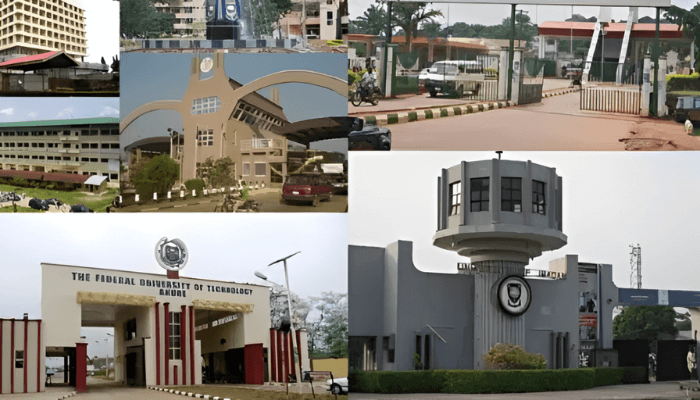
Below is a detailed look at the Top 10 Nigerian universities in 2026, featuring their history, academic strengths, leadership, notable alumni, and global recognition.
1. University of Ibadan (UI)
Founded in 1948 as a college affiliated with the University of London and becoming independent in 1962, the University of Ibadan remains Nigeria’s most historic and academically prestigious university. Located in Ibadan, Oyo State, UI has evolved into a national treasure a symbol of Nigeria’s intellectual foundation and global ambition.
Under the leadership of Professor Kayode Oyebode Adebowale, UI continues to blend tradition with innovation. The university boasts over 41,000 students across 17 faculties and a College of Medicine, reflecting its broad academic reach. Its research productivity and postgraduate output remain unmatched, earning it consistent recognition in international rankings.
UI’s alumni network reads like a who’s who of African excellence. From Wole Soyinka, Africa’s first Nobel Laureate in Literature, to legendary writer Chinua Achebe and environmental activist Ken Saro Wiwa, the institution’s global footprint is undeniable. UI was also the first Nigerian university to enter THE’s global top 1,000 band in 2016, a milestone it continues to uphold with its 2026 global ranking band of 801–1000.
More than just rankings, UI represents a legacy of resilience and scholarship. Its sprawling campus, featuring landmarks like Trenchard Hall, the UI Zoo, and the Botanical Garden, remains one of Nigeria’s most beautiful academic environments a perfect blend of history, greenery, and inspiration. (Official Website: ui.edu.ng)
2. University of Lagos (UNILAG)
Sharing the top spot with UI is the ever vibrant University of Lagos (UNILAG), established in 1962 and located in Akoka, Yaba, with campuses extending to Idi Araba and Surulere. With over 57,000 students, UNILAG stands tall as one of the largest and most cosmopolitan academic institutions in West Africa.
UNILAG’s strength lies in its diversity and dynamism. Led by Professor Folasade Ogunsola, the university’s first female Vice Chancellor, the institution has maintained a fine balance between academic excellence and urban relevance. Forbes once described UNILAG as a “startup powerhouse”, highlighting its culture of innovation and entrepreneurship.
Over the years, UNILAG has produced notable alumni who have shaped Nigeria’s political, academic, and creative sectors including Prof. Yemi Osinbajo, former Vice President of Nigeria; Wole Soyinka; and Grace Alele-Williams, Nigeria’s first female Vice Chancellor.
With a global band ranking of 801–1000, UNILAG’s commitment to cutting edge research, particularly in science, technology, and entrepreneurship, continues to attract both local and international collaborations. The iconic UNILAG Lagoon Front and the Senate Building at sunset remain symbolic images of the institution’s enduring brilliance. (Official Website: unilag.edu.ng)
3. Bayero University Kano (BUK)
Emerging strongly in the 1001–1200 global band, Bayero University Kano (BUK) continues to lead northern Nigeria in research and innovation. Established in 1962 as Ahmadu Bello College and upgraded to full university status in 1977, BUK has built a reputation for academic rigor and cultural inclusivity.
With an estimated 40,000 students, 17 faculties, and a College of Health Sciences, the university remains a hub for advanced learning in Islamic studies, health sciences, and engineering. Under the guidance of Professor Haruna Musa, BUK has invested heavily in research collaboration and infrastructure including the International Institute of Islamic Banking & Finance, which is the first of its kind in Nigeria.
The university’s international outlook score remains one of the highest among Nigerian universities. In 2022, BUK was recognized as the best Nigerian university for international collaboration, emphasizing its growing global engagement.
From its beautiful new campus gate to the BUK International Conference Centre, the institution represents the intellectual heart of northern Nigeria a place where tradition meets transformation. (Official Website: buk.edu.ng)
4. Covenant University (CU)
Once Nigeria’s undisputed No. 1, Covenant University, located in Ota, Ogun State, remains a trailblazer in private education. Founded in 2002 by Dr. David Oyedepo, the university revolutionized tertiary education in Nigeria by combining academic excellence with moral discipline and global standards.
Despite dropping slightly to a global band of 1001–1200 in 2026, Covenant University continues to lead in infrastructure, digital innovation, and employability. Its 4 colleges and School of Postgraduate Studies serve about 9,000 students, with a focus on entrepreneurship, leadership, and science driven problem solving.
The university’s alumni including Simi, Bez, Bimbo Ademoye, and Nonso Amadi showcase the diverse talents emerging from its system. Covenant was the first Nigerian university to ever reach THE’s 401–500 global band, a record that placed Nigeria on the international academic map.
The iconic Centre for Learning Resources Library and the University Chapel remain among Nigeria’s most photographed campus landmarks. Covenant’s continued innovation ensures it remains a reference point for excellence in private higher education. (Official Website: covenantuniversity.edu.ng)
5. Landmark University
Also within the 1001–1200 band, Landmark University in Omu Aran, Kwara State, is another private institution under the Living Faith Church umbrella. Established in 2011, Landmark’s vision is clear to transform agriculture into a tool for national development and youth empowerment.
Under Professor Kolawole Ajanaku’s leadership, Landmark University has developed a practical, research-oriented model that links classroom learning directly to agricultural production. With around 3,000 students spread across three colleges Agriculture, Science & Engineering, and Business & Social Sciences Landmark produces graduates ready to lead Nigeria’s food revolution.
The university’s emphasis on agripreneurship has inspired a new generation of Nigerian youths to see farming as a business, not a fallback plan. Most of the food consumed on campus is produced internally, making Landmark a model for sustainability and innovation in higher education.
Set against the serene Omu Aran landscape, with its scenic LMU Chapel, water fountains, and modern farms, the university’s campus stands as a living example of integrated learning and practical innovation. (Official Website: lmu.edu.ng)
6. Ahmadu Bello University (ABU), Zaria
Ahmadu Bello University, founded in 1962, remains the largest university in sub Saharan Africa by land area, occupying over 7,000 hectares in Zaria, Kaduna State. Its scale, legacy, and influence continue to shape Nigeria’s educational landscape.
Under the stewardship of Professor Adamu Ahmed, ABU accommodates over 50,000 students across 18 faculties and 110 departments, making it a powerhouse of research and manpower development.
The university’s contributions to agriculture, engineering, and medicine remain unmatched in northern Nigeria. With its global band ranking of 1201–1500, ABU continues to demonstrate excellence in teaching and research despite resource constraints faced by federal institutions.
Its landmarks, such as the Kashim Ibrahim Library and the Samaru Campus Senate Building, remain symbols of endurance, heritage, and academic leadership in Africa. (Official Website: abu.edu.ng)
7. Federal University of Technology, Minna (FUT Minna)
Located in Minna, Niger State, FUT Minna is a top tier technological university founded in 1983 to drive innovation and industrial development in Nigeria. With over 27,000 students and 10 specialized schools, it has become one of the nation’s leading hubs for scientific advancement.
Under Professor Faruk Adamu Kuta, the university has achieved recognition as a Centre of Excellence in Biotechnology, having produced Nigeria’s first carbon nanoparticles a groundbreaking contribution to nanotechnology.
FUT Minna’s focus on applied sciences and real world research has made it a preferred destination for students passionate about engineering, computing, and renewable energy. With a global band of 1201–1500, the institution’s steady growth reflects its commitment to technological self-reliance.
The university’s main campus gate and Search FM studio have become iconic representations of a school steadily shaping the future of tech in Nigeria. (Official Website: futminna.edu.ng)
8. University of Ilorin (UNILORIN)
Nicknamed “Better by Far,” the University of Ilorin continues to live up to its reputation. Established in 1975, the university has grown into one of Nigeria’s most competitive and efficient institutions, enrolling over 50,000 students across 16 faculties and more than 100 programmes.
Under Professor Wahab Egbewole, UNILORIN maintains a strong record of administrative stability and academic discipline factors that have earned it the title of Nigeria’s most sought-after university by JAMB applicants for 10 consecutive years (2014–2024).
The university’s global ranking of 1201–1500 is a testament to its commitment to research, student welfare, and infrastructure expansion. UNILORIN’s large campus, featuring its scenic water dam and Senate Building night view, offers an environment conducive to innovation and productivity.
UNILORIN’s alumni network spans every major sector in Nigeria, including governance, medicine, and entrepreneurship, reflecting the university’s consistent focus on producing solution-driven graduates. (Official Website: unilorin.edu.ng)
9. University of Jos (UNIJOS)
Rising from the scenic hills of Plateau State, the University of Jos (UNIJOS) remains one of Nigeria’s most visually stunning and intellectually vibrant universities. Originally founded as a satellite campus of the University of Ibadan in 1971, it became a full-fledged university in 1975.
Under Professor Tanko Ishaya’s leadership, UNIJOS serves more than 52,000 students across 15 faculties. The university has long been celebrated for its peaceful environment, academic excellence, and cultural diversity.
With a global band ranking of 1201–1500, UNIJOS continues to improve its research profile, particularly in social sciences, natural sciences, and ICT. Its strategic location in central Nigeria makes it a melting pot of cultures, fostering inclusivity and national unity.
The UNIJOS new permanent campus and its stunning hillside architecture reflect both its natural beauty and its ambition to be a globally competitive institution. (Official Website: unijos.edu.ng)
10. University of Nigeria, Nsukka (UNN)
Established in 1960 as Nigeria’s first indigenous university, the University of Nigeria, Nsukka (UNN) remains a symbol of academic pride and innovation. With 60,000 students, 17 faculties, and over 100 departments, UNN’s influence on Nigerian education is unmatched.
Led by Professor Simon Uchenna Ortuanya, UNN has continued to drive groundbreaking achievements, including the historic first open-heart surgery in sub Saharan Africa, performed at the University of Nigeria Teaching Hospital (UNTH) in 1974.
UNN’s global ranking of 1201–1500 underscores its resilience in maintaining academic quality across its four campuses. The Freedom Square and the Lion Statue at Nsukka remain iconic symbols of its enduring legacy a place where knowledge roars.
As Nigeria’s pioneer university, UNN continues to uphold its motto, “To Restore the Dignity of Man”, through impactful teaching, research, and innovation. (Official Website: unn.edu.ng)
Why Federal Universities Dominated the 2026 Rankings
The 2026 THE Rankings highlight a clear pattern: federal universities have regained their dominance. The combination of increased government funding, stronger research networks, and international collaborations gave public universities a competitive edge.
Private institutions, while maintaining quality, faced challenges related to global visibility and citation impact. Federal universities like UI, UNILAG, and BUK leveraged decades of institutional history and alumni networks to reclaim their spots on the global stage.
For Nigerian students and parents, this ranking sends a strong message public universities are back, stronger and more globally relevant than ever before.
Conclusion
The Top 10 Best Universities in Nigeria have demonstrated resilience, innovation, and world class potential. From the historic halls of UI to the entrepreneurial spirit of UNILAG and the scientific drive of FUT Minna, these institutions continue to shape the nation’s future.
Which university are you rooting for this year? Share your thoughts in the comments below and don’t forget to follow LearnHub Nigeria for more insights into Nigerian education, scholarships, and campus life.
Elvis Oscar (aka Emekus) is an SEO expert, content writer, and WordPress developer.
Passionate about helping brands grow online. Skilled in keyword research and Google analytics, he creates strategies that drive visibility and engagement. He is also the founder of LearnHub.com.ng, a platform dedicated to sharing knowledge, resources, and insights on digital.